


Aotearoa & Beyond: Glaciers, Glowworms, and a Fijian Finale
Updated: Apr 19

A journey through New Zealand’s North and South Islands, ending in Fiji
We didn’t fully understand New Zealand until we were there. You can see the photos and hear the stories, but none of it prepares you for how quickly it gets under your skin.
We left San Francisco on a night flight and, two days later, stepped into a soft late-summer haze over Auckland. It felt distant in every sense—geographically, yes, but also in rhythm, as if we had arrived somewhere operating on a slightly different frequency. What followed was a trip that built on itself: glowworm caves that felt like a private galaxy, long drives through landscapes that didn’t feel entirely real, a glacier you could actually stand on—and eventually, a complete reset on a quiet island in Fiji.
New Zealand: A bicultural community
New Zealand is named after the Dutch province of Zeelan, Nova Zeelandia which translates to "New Sea-land" and was anglicized to New Zealand. What struck us is how strongly New Zealand presents itself as a bicultural nation that actively centers its Māori heritage in public life. Te reo Māori (the Maori voice) permeates daily life through bilingual government names and greetings like "kia ora" (hello) in schools and workplaces, while the haka, once primarily a Māori war dance, has evolved into a powerful symbol of national identity. It doesn’t feel like history being preserved; it feels like culture being lived. Aotearoa is the Māori name for this land. That was one of the first things that stood out to us—how naturally the Kiwis hold both identities at once.
Auckland: An Unexpected Start
We’ll admit it—we almost treated Auckland as a stopover. We gave it three days, and we were rewarded. There’s an energy to the city that isn’t obvious at first. Auckland sprawls across a narrow volcanic isthmus between two harbors — the Waitemata to the east, the Manukau to the west. It’s spread out but doesn’t overwhelm you in the way big cities sometimes do.
We happened to arrive during the Pasifika Festival, and that ended up shaping our entire first impression. Music, food, performances from across the Pacific—a community celebrating itself. We were just there, alongside local families enjoying the same sunlit afternoon.

In between, we kept things simple. Walking through Albert Park. Spending time around the University of Auckland campus. Even just sitting by the Viaduct Harbour, watching boats drift in and out while figuring out where to eat next. Nothing dramatic—just the kind of slow start that lets a place settle in.
A day trip to Waiheke Island, a 35-minute ferry ride from the Downtown Ferry Terminal, is one of Auckland's best-kept open secrets. We took the early morning Fullers360 ferry from Pier 13/14 arriving at Matiatia Wharf as the vineyards are just waking up. We walked to Oneroa village, stopped for coffee, then made our way to Cable Bay or Mudbrick for a long lunch with views that justify of the journey. The island's hilly terrain is planted thick with olive groves and pinot noir vines, and on a clear late-summer day, the light here has a quality that photographers chase. We didn’t plan it too tightly—just moved around by bus, stopped when something looked interesting, and let the day unfold.
Pro tip: You can use any credit card or apple/google tap on/off on all public transportation.On our final full day in Auckland, we handed ourselves over to a 12-hour guided tour (Cheeky Kiwi) that turned out to be the most densely remarkable day of the entire trip. The destination: Waitomo Glowworm Caves and Te Puia in Rotorua.
The Waitomo Caves have been around for millions of years, but what stays with you are the glowworms. You walk through the dark caves which is super cool, then drift silently in a small boat, looking up at a ceiling that genuinely feels like a night sky. No photograph truly captures the experience. Also, they’re not actually worms, but the larval stage of a fungus gnat— “glowworms” is clearly the better name.

Te Puia, in the heart of Rotorua's geothermal valley, is a different kind of revelation. The air smells of sulfur but within minutes you stop noticing. What demands your attention instead is the Pōhutu Geyser erupting skyward with percussive force, the mud pools boiling in great slow bubbles, and the extraordinary cultural performance that follows: a full Māori cultural experience including the haka — a war dance of such physical intensity and emotional power that it leaves first-time witnesses slightly breathless.
We flew in and out of Auckland Airport—a major hub that, despite its importance, feels like it’s overdue for an upgrade.
Queenstown: The Edge of It All
Queenstown has a reputation for adrenaline—skydives, bungee jumps, the kind of experiences that make for good stories. But what struck us was the setting, it is just stunning. The town sits lightly along the edge of Lake Wakatipu, ringed by the jagged line of The Remarkables, as if it had been placed there with deliberate restraint.
We arrived midweek, stepping off the plane into air that felt immediately different—cooler, sharper, almost clarifying. It wasn’t just a change in temperature; it was a shift in pace and tone. What stayed with us wasn’t the abundance of things to do, though there are plenty, but the quiet luxury of choice—the sense that whatever direction you turned, something memorable was waiting. It also helped that our Airbnb was perched at the edge of the fabulous Queenstown Gardens with views of the lake. Our host, Digby was amazing and seeing the downtown unfold as he walked us down a treelined sloping path was the highlight of the trip.

You cannot not go to Milford Sound—a grueling 14 hr. roundtrip. The journey that begins long before you reach the water as your glass-roofed coach winds through Fiordland National Park for several hours, passing Mirror Lakes, the dramatic gorge of the Homer Tunnel — blasted through 1.2 kilometres of sheer rock — and finally descending into the valley that holds Milford Sound. Carved by glaciers over millions of years, Milford Sound is 15 kilometres long and surrounded by sheer rock faces that plunge thousands of meters from summit to sea. Mitre Peak, the fjord's most iconic landmark, rises 1,692 meters almost vertically from the water's edge. On the cruise, Bowen Falls (161 meters) and Stirling Falls (155 meters) pour in great white sheets directly into the fjord — close enough to lean over the bow rail and feel the mist on your face. We packed our own lunch and snacks for the long drive.
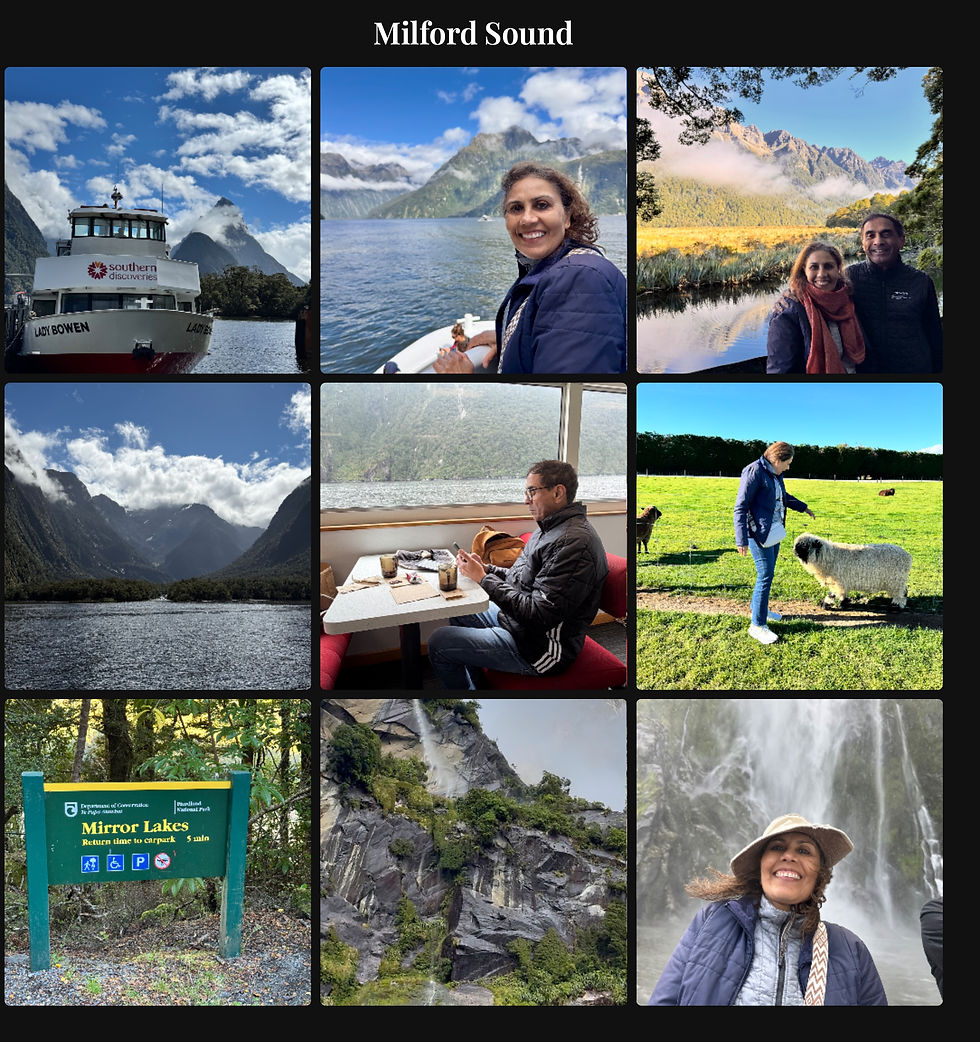
Insight: Milford Sound is misnamed. It is a “fjord” because it was carved by glaciers, not a “sound” which is carved by a river. Pro tip: We’d recommend staying in Te Anau if you are self-driving to break journey. Or take a tour with Southern Discoveries.Friday leaned fully into Queenstown’s adventurous side. Joe tried hang gliding. Standing at the edge of Coronet Peak, harnessed in and trying not to overthink it, there’s a brief pause before the run—just enough time to question the decision. And then you’re airborne. What follows is quieter than expected. The initial rush gives way to something almost meditative—gliding over ridgelines, suspended between sky and valley, with Queenstown stretched out far below. Equal parts exhilarating and unnervingly calm, it ended up being one of those rare experiences that stays with you long after the adrenaline fades.
The South Island Road: Waterfalls, Ice, and a Moving Landscape
We picked up our SUV at Queenstown Airport on a clear Saturday morning and headed west, leaving the Southern Alps behind us. The drive toward Franz Josef Glacier via Haast Pass isn’t just a transfer between places; it feels like a gradual unfolding of landscapes.
Our first stop was Wānaka, a lake town that feels like Queenstown’s quieter, more reflective counterpart. Breakfast at the Federal Diner—tucked away enough that you feel slightly let in on a secret—set the tone. We walked along the lakefront for longer than planned, aware we had a glacier ahead of us but reluctant to leave.
Beyond Wānaka, the road enters Mount Aspiring National Park and begins to shift in character. Everything feels larger, wetter, more elemental. Past the remote outpost of Haast, the West Coast reveals itself in a series of brief, almost effortless detours that feel disproportionately rewarding:
Blue Pools — a short walk through beech forest to a suspension bridge over water so clear and turquoise it looks edited.
Thunder Creek Falls — suddenly there, right off the road: a 96-metre drop of water cutting straight from rainforest cliff to riverbed.
Roaring Billy Falls — quieter, more hidden, but with that unmistakable West Coast light filtering through dense green canopy.
By the time we reached Franz Josef Glacier, the landscape had fully shifted. The glacier itself is extraordinary—not just for its scale, but for where it exists: ice descending through temperate rainforest to within a few hundred meters of sea level. It is one of the few glaciers in the world in such proximity to dense forest, and visibly changing year by year.

We had planned a heli-hike, but weather redirected us into a glacier encounter instead. At Glacier Base on Cron Street, the experience began with a helicopter flight over the valley—an ascent that immediately removes any sense of scale you think you have. From above, the glacier is not static at all: crevasses open like fractures, and blue ice forms towers and ridges that look carved rather than formed. We landed briefly on the ice itself. Standing there, it becomes clear that this is not a frozen landscape in the conventional sense—it moves, subtly and continuously, under its own weight. On the return flight, we caught a wide sweep of Fox Glacier and, in the distance, the outline of Aoraki / Mount Cook, before dropping back into the green stillness of the valley floor.
Pro Tip: Book with Franz Joseph Glacier Tours, the guides are the best in the business.We took the legendary TranzAlpine train from Greymouth to Christchurch. We had driven from Franz Josef that morning, dropped the car at Greymouth Railway Station and spent the late morning exploring this small port town on the West Coast before settling into our train seats. The TranzAlpine from Greymouth to Christchurch is worth it less as transportation and more as a slow reveal of the South Island’s geography—an engineered front-row seat to some of the most dramatic terrain in the country. You start on the West Coast near Greymouth, where everything feels damp, dense, and almost horizontal—rainforest, rivers, and low cloud. Within an hour, the train begins climbing into Arthur's Pass National Park, and the environment tightens dramatically: braided rivers give way to steep valleys, then sheer alpine walls, then high-country emptiness. At its highest point around Arthur’s Pass, you’re essentially moving through a corridor cut through the Southern Alps, with open-air carriages letting you feel the temperature drop and the wind sharpen as you cross the divide.

Then comes the descent into the Canterbury Plains—arguably the most surprising transition of all. The jagged alpine world slowly dissolves into wide, agricultural flatlands that feel almost infinite after the confinement of the mountains. The most striking are the viaduct crossings in the alpine section, where the train glides across narrow gorges on slender steel structures that feel almost minimal against the scale of the Southern Alps. For a few seconds at a time, you’re fully exposed—river far below, mountains rising abruptly on either side, wind and space opening up through the carriage windows.
Pro Tip: They have a lovely café on board, very inexpensive, so do visit and try and get seats towards the back of the train, it’s less crowded and closer to the open-air carriage.Christchurch - A masterclass in resilience and renewal
This is a city in the middle of becoming something new. The 2010 and 2011 earthquakes destroyed much of the city center, and what has emerged from that devastation is a quietly fascinating urban story. The Cardboard Cathedral — built from cardboard tubes and polycarbonate panels as a transitional cathedral after the original was damaged — is now a permanent, beloved landmark. Its original inspiration came from Japan. The rebuilt precinct is a live laboratory of architectural experimentation. The Botanic Gardens remain immaculate and serene. The Riverside Market is a triumph of local food culture — stalls of artisan cheese, freshly baked pies, Asian dumplings, mezze and more. We were thrilled to discover Rutherford’s Den, dedicated to Ernest Rutherford, preserved in the Clock Tower at The Arts Centre in Christchurch. He is the "father of nuclear physics" and studied at Canterbury College (now the University of Canterbury).

Would highly recommend a day trip to Lyttelton, a vibrant port town 40 minutes (by bus) from Christchurch, known for its maritime history, steep streets, and the historic Timeball Station. The earthquake that struck the Canterbury region in 2011 was centered near this town. We had the best time strolling its hilly neighborhoods and admiring the homes. On our walk toward the Timeball Station, we stopped outside a home I’d been admiring when a retired couple came out and struck up a conversation. What started as a passing comment quickly turned into an invitation inside. They showed us through their house, then out into greenhouses and gardens that clearly carried years of care and quiet pride. We stayed far longer than intended—sitting over coffee, talking about their lives, and looking out at the harbor views as the afternoon slipped away without any urgency to leave.
Pro Tip: Have coffee and breakfast at the stunning Lyttelton Coffee Company.Fiji: The Art of Doing Nothing Exceptionally Well
We flew from Christchurch to Nadi where heat wrapped around us like a warm towel. The relief of it — after days of alpine cold and glacier winds, was perfect.
Fiji has been welcoming strangers for centuries with a particular brand of warmth that cannot be manufactured or replicated. There are no schedules here, only the rhythm of the tide. The one word you hear everywhere in Fiji is “Bula!”—a greeting that carries more than its translation suggests. It can mean hello, welcome, life, health, and a dozen other things depending on how it’s said. It’s warm, immediate, and disarming in the best way—and it’s impossible not to reciprocate. We spent our first night in Wailoaloa Beach, 15 min from the airport with a great walking beach and uninterrupted views of the ocean. Early the next morning we took the Malolo Cat ferry that departed Denarau Marina and threaded through the Mamanuca Islands, a scattering of coral atolls and reef-fringed islets that make up one of Fiji's most beautiful marine environments, arriving at Musket Cove on Malolo Lailai Island in under an hour.

Musket Cove Island Resort & Marina sits in the Mamanuca Islands and feels far removed from anything resembling a schedule. It’s both a resort and a marina, set around a calm lagoon edged by palm-lined beaches and low-key villas rather than anything overly formal or staged. What makes it memorable is the water itself—clear enough that you can see reef patterns shifting beneath a kayak—and the ease of slipping into it. Snorkeling here doesn’t require much planning; you’re quickly in water that holds parrotfish, small reef sharks, and coral gardens within a short swim from shore. There’s a sense that the ocean is simply part of the resort’s layout rather than something you go out to find. Days naturally take on a slower rhythm: kayaking across the lagoon, stand-up paddleboarding in the late morning heat, or reading without looking at the time. Even meals stretch out longer than expected, especially lunches that turn into afternoons. By evening, everyone gravitates toward the beach bar as the light softens over the Mamanucas, cocktails in hand, watching the sun drop into the horizon without any sense that it needs to be rushed.
The last day arrived sooner than expected. The ferry back to Denarau was unhurried—one last swim in the lagoon, breakfast on the deck, and a final look at a horizon that already felt distant from San Francisco. From Nadi Airport, the overnight flight home was straightforward, though inevitably a little quiet in that familiar way endings tend to be.
Looking back, what stands out is how naturally the trip moved between two very different moods. New Zealand was all scale and motion—landscapes that felt immediate, moments of adventure that kept pulling attention outward. Fiji, by contrast, slowed everything down. It softened the edges, made space for stillness, and turned simple days into something unforced and easy. Together, they formed a rhythm that felt complete without needing to be shaped into anything more than it was.


Beautifully written Mona. Love how you notice things, landscapes , vibes around you. Thank you. 👏👏👏